

Acerca de Karl-Henrik Krantz

Este autor aún no ha proporcionado ningún detalle.
So far Karl-Henrik Krantz has created 23 blog entries.

Limpieza acústica: Un paso hacia la disponibilidad constante de la caldera

Obstrucción y reducción de la transferencia de calor Al exponerse a la suciedad, las superficies de transferencia de calor pierden eficacia con el tiempo debido a las incrustaciones y la acumulación. Esto impide que las calderas de potencia alcancen todo su potencial. Para liberar el potencial de la caldera, es necesario limpiarla. Una forma en que la mayoría de las plantas del mundo hacen esto es limpiando manualmente el área deseada durante una parada programada. Esto, sin embargo, representa una pérdida importante en la producción de energía. En esta sección presentamos tres plantas que tenían grandes problemas con esto antes de implementar la limpieza acústica. Haga clic en su nombre para descargar un caso de estudio detallado: Mälarenergi, Kraftvärmet Block 6: Una planta de valorización energética de residuos sueca que tenía que detener el funcionamiento de su caldera para chorrear con arena el economizador cada 3-6 meses. Sandviksverket, Växjö: Una caldera CFB sueca, alimentada por biomasa, que redujo su consumo de vapor para soplado de hollín en un 50% en el precalentador de aire y el economizador. El limpiador acústico también eliminó por completo la necesidad de soplar hollín en el catalizador. EEW Delfzijl, Holanda; [...]

Por |2023-10-26T11:12:38+02:0026 de octubre de 2023|Limpieza por infrasonido, Calderas de potencia|Comentarios desactivados Limpieza acústica: Un paso hacia la disponibilidad constante de calderas

Revelando al culpable silencioso: mayor consumo de combustible debido a la suciedad

La caldera de combustión está en el corazón de muchas operaciones. Ya sea una caldera de potencia que opera en una planta de calefacción combinada o una caldera de recuperación en una planta de celulosa y papel. Permiten que los procesos funcionen sin problemas y de manera eficiente si se les da el mantenimiento adecuado. Las calderas tienen un enemigo universal que no solo afecta su eficiencia, sino también los resultados financieros: la acumulación de incrustaciones (fouling). Una de las consecuencias más pasadas por alto de las incrustaciones graves es el aumento en el consumo de combustible. Por lo tanto, es importante mitigar el problema antes de que las consecuencias se vuelvan insoportables. ¿Por qué aumenta el consumo de combustible debido a las incrustaciones? El rendimiento general de la caldera depende en gran medida de un intercambio de calor eficiente. El calor debe fluir desde las cámaras de combustión hacia el agua, generando vapor que es esencial para diferentes procesos en la planta de combustión. La acumulación de depósitos en las superficies de la caldera perturba el intercambio de calor; esta noción está bien documentada y es bastante aceptada. Sin embargo, el culpable oculto es que, para mantener el mismo vapor [...]

Por |2025-04-23T14:24:48+02:001 de septiembre de 2023|Artículos optimizados sobre soplado de hollín por vapor, Calderas de potencia, Calderas de recuperación|Comentarios desactivados Revelando al culpable silencioso: mayor consumo de combustible debido a la formación de incrustaciones

Revolutionizing Fuel Analysis for Pulp and Paper mills: Heat Management’s Newest Tech Acquisition

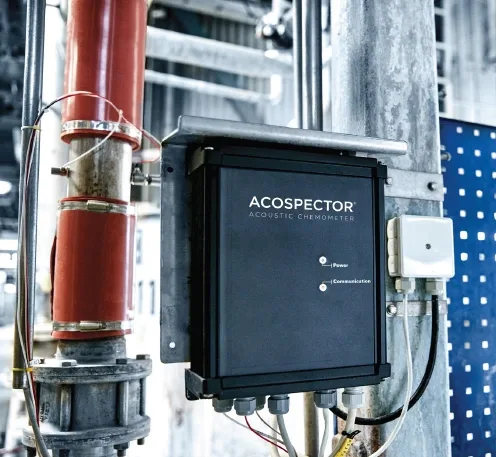
The Acospector takes a whole new approach on process optimization and fuel analysis. With various software packages the impossible has become possible with this technology that enables analysis that can help users to avoid unwanted process modes. Wave Impact Heat Management AB and The Packaging Greenhouse AB has in a joint venture strategically acquired the technology to expand their portfolio, to offer their respective customer bases optimized operations. What is the Acospector? The groundbreaking technology was developed by Acosense, renowned for their expertise in fuel analysis. Although the company is no longer in operation, Heat Management sees the immense value of the past flagship product of Acosense. The hardware is installed on the customers pipes where the fuel is passing through. With unprecedented non-disruption to the customers production cycle. The solution does not require any boiler shutdown to be installed and commissioned, it seamlessly integrates in the customers infrastructure. Through acoustic signals, measurements are collected that is later analysed within [...]

Por |2023-08-07T12:59:46+02:00agosto 7, 2023|Noticias, Calderas de recuperación|Comentarios desactivados en Revolutionizing Fuel Analysis for Pulp and Paper mills: Heat Management’s Newest Tech Acquisition

Sappi Gratkorn Implements Overlapping Sootblowing Technology to Lower Environmental Impact

Sappi Gratkorn is a paper mill in Austria that produces high-quality multi-coated paper. The mill has been in operation for over a century. In recent years, the company Sappi and their respective mills have been investing in developing their facilities to reduce their environmental impact.  The newly formed sustainability partnership Sappi Gratkorns goal was to reduce their steam consumption and therefore reduce their annual cost of lowering their environmental impact.  In the year 2021, Sappi Gratkorn entered into a sustainability partnership with Heat Management to investigate ways of furthering their eco-effective journey. It was determined that Heat Managements High Impact Sootblowing System (HISS®)  was an appropriate solution to implement into the boiler's superheater, in order to achieve more sootblowing with less steam. Sappi Gratkorn, like most red liquor recovery boilers, operates the steam sootblowing in separate cycles. This makes the HISS® operation comparable to power boilers with various fuels like biomass and waste. Sappi Gratkorn is renowned for streamlining its [...]

Por |2025-04-23T14:31:18+02:00junio 28, 2023|Artículos optimizados sobre soplado de hollín por vapor, Calderas de potencia, Calderas de recuperación|Comentarios desactivados en Sappi Gratkorn Implements Overlapping Sootblowing Technology to Lower Environmental Impact

The Swedish Energy Agency recognizes the potential in Heat Management’s CleanTech Solutions

CleanTech for Pulp and Paper Mills with Financing From the Swedish Energy Agency Heat Management has been at the forefront of revolutionizing the development of fouling prevention in industrial boilers. CleanTech is our passion and to push our products and the value for customers beyond technical specification. By setting the standard for boiler performance with patented solutions, and not being content with how boiler cleaning has been done in the past we help the industry to reach a new level. This has now been recognized by the Swedish Energy Agency and an initiative to help pulp and paper mills invest in modern CleanTech solutions has been initiated. The need to optimize boiler cleaning operations  A recovery boiler has heat transfer surfaces inside that are exposed to ashes in the flue gas. It is desirable to keep the fouling rate as low as possible to be able to operate the boiler for as long time per year as possible. It is [...]

Por |2025-04-23T14:33:48+02:00junio 22, 2023|Noticias, Calderas de recuperación|Comentarios desactivados en The Swedish Energy Agency recognizes the potential in Heat Management’s CleanTech Solutions

Why Lignin Extraction Usually Comes with a Catch 

Many pulp and paper mills are looking for ways to compensate for the environmental impact of their operations while reaching global and internal sustainability goals. One common approach is enabling the possibility to replace oil as a building block in the production of high-value products with lignin. A natural fiber in almost every living plant, lignin plays a large role in wood’s ability to retain its characteristic stiffness and resiliency against decay. Not only does lignin present amazing opportunities to replace fossil-based materials with renewable materials, but it can also decrease the discharge of pollutants. However, lignin extraction comes with a catch.   The high costs and safety risks of lignin extraction  Before lignin can be put to use as an alternative building block, it must first be extracted from a by-product of the Kraft pulping process called Black Liquor. In addition to lignin, Black Liquor consists of hemicellulose and inorganic compounds. Black Liquor is used to supply pulp for [...]

Por |2023-05-31T10:39:56+02:00mayo 29, 2023|Calderas de recuperación, Artículos optimizados sobre soplado de hollín por vapor|Comentarios desactivados en Why Lignin Extraction Usually Comes with a Catch 
Ir arriba